Thursday, February 25, 2016

It's the Small Things

During guided reading a fifth grade boy stumbled on a word that started with a d. After he slowly decoded it correctly he looked up at me with a huge smile on his face and exclaimed, "Hey! Do you remember when you taught me that strategy, like, years and years ago?"

OK-

1) I've taught you a lot of strategies

2) Years and years ago? Two. It was two years ago when you were in third grade. But I guess that can feel like a lifetime ago when you are ten.

3) We JUST talked about the importance of attending to the book and not getting distracted by outside information. I should tell you to get back to work, but now I'm curious. Plus, being able to articulate your strategies is always a good meta-cognitive skill.

"No...  which strategy?" I asked, biting my tongue to keep in my reminder to keep reading.

"You know, the B, D one! BED!" he proudly showed me turning his fingers into a b and a d to make the bed. "I use it ALL THE TIME! And I did it just then, under the table. I wasn't sure if that was d, and then I checked, and it was!" He is beaming with pride and suddenly I am too.

Yes, in third grade I taught him that strategy so he could check if a letter was a b or a d. I didn't think he heard me, or cared to even use it. I had no idea he ever tried it- not once. And here it is, two years later and he's telling me he used it all the time? Secretly? I was taking a running record on him and attending closely to his reading behaviors and I had no idea he was moving his hands under the table to do anything but fidget. He's clearly working hard on hiding his confusion, but instead of giving up he's found a work-around.

So many of the rewards in teaching are found in these little moments. Moments that are easy to overlook and aren't reflected in the data. But it's the small things- a kid sharing one way you've helped him over the years, that remind us of why we do what we do.


Friday, February 19, 2016

Poverty, Teachers, and Public Image

The New Yorker recently published a piece calling for the end of humiliating teachers. I found it emotionally hard to read, perhaps because seeing the teacher struggle laid out there in black and white made it too real. The article summarizes the fall of the profession under the standardized testing movement, what tying school success to test scores has done to the teaching culture, and the need to make teaching a viable career path to support a middle class family. It also identifies the real culprit to our schools' struggles not as the teachers themselves, but poverty.

After teaching for four years in a "no excuse" school, where we are not allowed to mention poverty as a reason a student may be performing below grade level, I find myself shying away from any mention of poverty as a reason for poor performance. I do believe that as teachers we need to hold all students to the same measures of accountability, and that we cannot use poverty or disability as an excuse. We need to do whatever we can to get every student in front of us up to grade level. We cannot control what is going on outside our school's walls. We cannot guarantee our students have health care coverage, enough food, and proper supervision, but we can fight as hard as possible to ensure they are being given the absolute best education they can get when they are with us.

But the article brings the use of poverty into another light. It states,
"the dismaying truth is that we don’t know how to educate poor inner-city and rural kids in this country. In particular, we don’t know how to educate African-American boys, who, according to the Schott Foundation for Public Education, graduate high school at rates no better than fifty-nine per cent." 

Yes, it says we need to address health care and universal preschool, but it also brings about a stark reality- we don't know how to educate poor inner-city and rural kids. What we are doing is not working. At my own school we see this reflected in the behavior data. Our students may be succeeding according to academic numbers, but the data that looks at students' engagement in school and whether or not they've been disciplined points out that something is not working in how we are teaching our minority boys. So what are we missing? What is it that is not working?

Is the public right to blame us? Is it the school's role to look inward and change our approach? Or is it society's role to change early intervention programs, health care, and address poverty itself? Can the schools even begin to change their approach when their hands are tied trying to meet test scores benchmarks? I could argue both sides- the importance of schools making the changes themselves as well as the importance of changing the testing culture so that we free schools up to be creative and open with the students they serve.

Whatever the answer, let's paste the article on every surface imaginable and begin to turn the tide on how the public views teaching. Let's stop humiliating teachers so that we attract quality teachers to the field. Let's get the best and brightest minds to start examining the question of how to make changes so we can better educate all students.


Friday, February 12, 2016

Parent Torture and Valentines Day.


 Once again my now experienced parenting self would like to apologize for my child-less teacher self. This time it's for assigning a horrendous project that I had no idea was so painful to complete at home. I assigned it every single year, and often patted myself on the back for all the literacy skills I was able to sneak into the project. Childless Mrs. Lipstick thought that this project was a great, exciting, and organic way to at the very least encourage students to write their name, identify their friends' names, and practice basic literacy skills. At its best it encourage creativity, a chance for parent/child bonding, and problem solving.

I hate Childless Mrs. Lipstick.

My daughter's preschool teacher assigned the same assignment.

Valentines Day cards.
Innocent, no?
Childless me LOVED this assignment. I made a big deal about how the students were supposed to write their OWN names on the cards. I didn't want to see their parents' handwriting. I also sent home baggies of red, white, and pink squares of paper so they could create their own handmade valentines. Look! I'm saving mom and dad from spending money at the store on those cheap cards! No excuse for not sending them in. I had no idea you could buy them at the Dollar Store. Or how long it takes to create 25 valentines cards with a child who is really proud of their first card and now would like to go practice forward rolls or play in the doll house.

I hate childless Mrs. Lipstick.

My daughter's preschool class said nothing about making their own valentines, but I knew there was no way my daughter could write her own name on those tiny store-bought cards, and I also knew that I was not going to stay up late Thursday night writing her name 25 times. I saw absolutely no value in that. I figured she needs to practice writing her name, this is a great way to do it, so we'll just make our own valentines.

With materials we bought from the dollar store (I want to note it would still have to been cheaper to buy one packet of already-made valentines) we set about creating fun heart-based pictures. Most of these were her idea. She discovered you could make a butterfly if you put a pop-sickle stick on top of a heart with a pom pom for a head. I can guarantee you that she regrets that discovery now. That was a great idea if she wanted to make ONE valentine. But we needed 25. So, slave driver mom forced her to keep working. She'd finish one and proudly show me and I'd barely look up. "That's great sweetie, now do another one! We still have 20 to go!"

Once we finally finished and sat back to admire the 25 beautiful cards she still had to write her name on them. Three days. We spent three evenings after school encouraging, cajoling, begging, demanding that she write her name in a legible fashion. She may never write her name again.

The final product is beautiful, and more importantly finished. Just in time for her to take to school, proudly deliver to her friends, and for their parents to throw them in the trash with the rest of the store-made cards. AND I'm not even giving this project the time it takes to figure out how to rotate the pictures on the blog. Because, while I love her beautiful work, her wobbly little butterfly antennas and her random pom pom balls, we're done. Project complete.

Happy Valentines' Day.

Parents everywhere- I am sorry. I will never roll my eyes at store bought cards again.


Tuesday, February 9, 2016

The Students Needs vs My Needs

Last week I did one of the hardest things I've done as a teacher. I suggested that one of my favorite guided reading groups work with another teacher.

It killed me to do it. (If I said that phrase in the reading group one of the girls would immediately note my use of figurative language. I love this group.)

It especially hurt because just the day before one of the girls in the group snuck into my office at dismissal and told me how lucky she was and I worked together in reading.

I've been working with this group for two years now. Members have left and some have joined, but from April of last year until now we have been a set group. One of them came into the country last year. If we didn't switch her reading group I would be the only teacher who gave her guided reading instruction in the United States.

One of them in particular has made phenomenal progress. I am so proud of him. I thought about him all summer and determined that this year my main goal is to get him to grade level. I was sure we could do it. At our first quarter conference I told his mom about my plan and promised that I was going to do everything I could to get him to grade level.

After giving the mid-year reading assessment and analyzing his results I realized he is making some of the same mistakes he made a year ago. These errors aren't holding him back enough to impact his overall score on the test, but reading is not about one overall passing score. It is about putting all of those skills together. He needs all of those skills. The whole group does.

Everyone in the group is doing well and is making progress. Not at grade level, but moving towards it. If you look at just the score it looks like they are doing fine. But I want more for them than fine.  If I really want them to kick it into gear and get to grade level before middle school it is time for something drastic. I thought a lot about that promise I made to one mother, and I thought about the group's frustration over test prep and how much I want them to be able to sit confidentially for the end of the year testing. They need something different.

On paper, every one of them has an excuse for not performing on grade level, so it would be easy to look at their progress and say, "Oh, OK, no worries here. From kids with their backgrounds this is the progress we'd expect." But I know they can do it. I one hundred percent believe we can bring them to grade level.

I've written about how my school does reading groups here, and how effective it is. When we sit down to make groups the entire grade sits down together with the English as a Second Language teacher, the special education teacher, the reading specialist, the advanced academics teacher, and sometimes even the technology specialist. We look at the entire grade level's reading abilities and create groups from there. Groups are set, we go out and teach, and then come back together 6-8 weeks later to discuss their progress and make new groups if their needs have changed or if they need something different.

I think it is time for this group to get something different. Just a new perspective, new energy, a new approach. While they are working with another teacher I plan to keep tabs on them and see if their comprehension skills change. If so, then I hope to look at what their teacher is doing and learn what I can do to improve my teaching for the future.

There is a lot of doubt in this decision. That tiny voice inside my head asking, What if they don't connect with another teacher? What if the other teacher doesn't push them as hard as I have, or does not believe they can do it as much as I do? There is a lot of trust I have to put in my co-workers in order to even broach the subject.
I worried that the words to suggest the change would not even exit my mouth. If I am honest with myself I feel a sense of ownership over this group. They are mine. They've been mine for two years. I've been proud of how well they've done, which makes it even harder to suggest that they work with another teacher. But it is not about me. It is not about my teaching skills, my ego, pride, or the bright spot in my day. It is about the kids.


Monday, February 1, 2016

We Survived the Snow Days!

We are about to go back to school after 7 snow days at home- that's 9 straight days of pajama wearing excitement if you count weekends. What's more, all of this happened right after a three day weekend and a teacher workday, meaning that the students have only gone to school ONE day since January 15th. That seems like a long time ago. This week is going to be rough.

Or maybe not. Maybe the students will have been so bored at home that they are anxious to get back to school. (One can dream, right?)

In the Lipstick household we ended up being out of town for a significant part of the blizzard, which meant we didn't go quite so stir-crazy as the rest of you. We had two different settings to sled, sip hot chocolate, chase each other around like maniacs, and fight over wearing the same PJs for days in a row.

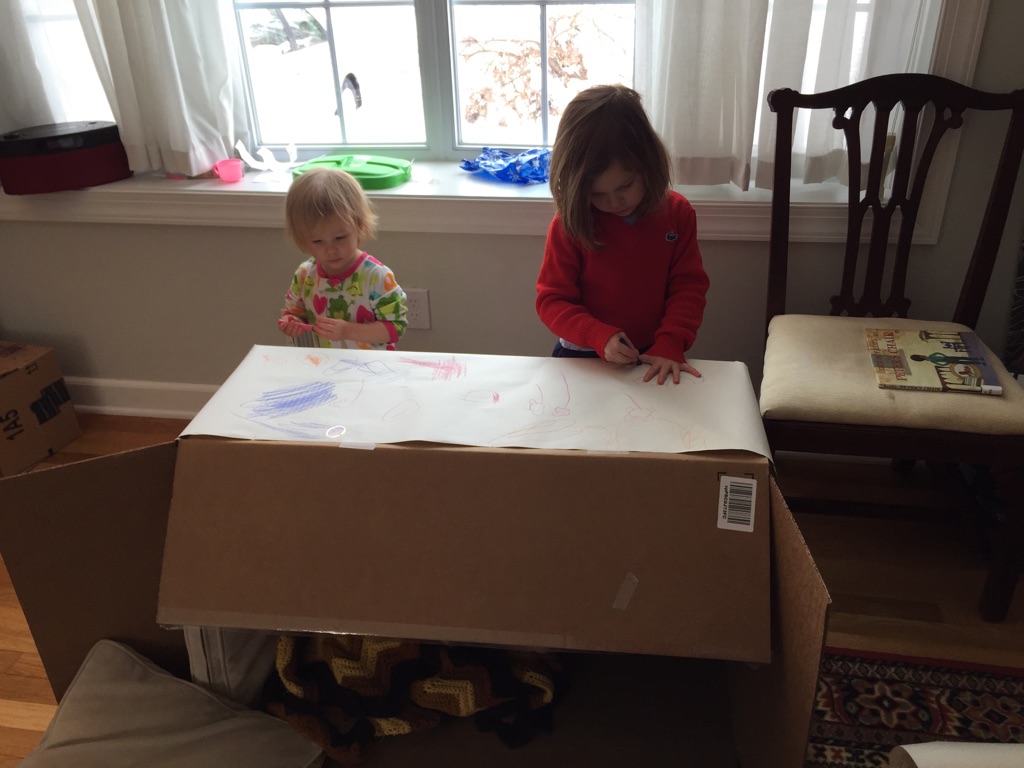
In a moment of brilliance (or, eh, insanity, but those two are so closely linked) right before the snow hit I ordered a blow-up wading pool and balls for a ball pit. We've done this in the past but our previous wading pool had popped and we needed new balls. The new balls were the key to this because they arrived at our door in a massive box. A massive box just begging to become a little house.

My children have played with the ball pit a bit, but spent most of their pajama-clad snow day time inside the box.
Four year old tries to keep one year old in one place...
It's a house! It's an art table!


Windows are obviously for climbing through
I'll just sit here and sip my coffee since both my children are nicely situated inside the box.


The balls. Oh, hello regret. The almost-two-year-old thinks the ball pit is for turning upside down to watch the balls roll across the room. She has no problem cleaning them up, as long as she can immediately throw them on the ground again. I should have just ordered the box.

Wednesday, January 27, 2016

How do we grant this wish?

 The day before the snowstorm I was working one on one with an upper grade student. I was challenging him through the type of work I was giving him and in return he would frequently give me dramatic, "You are killing me! I'll never survive" quotes. Despite his complaints I could see his effort coming through. He shouldn't have been able to perform as well as he was- and yet he was working extremely hard to get answer my questions. Of course, he was frantically trying to hide all of his academic struggle behind his overly dramatic expression of how I was the meanest teacher ever.
As we neared the end and I was packing up my things he said, "If I could have any super power do you know what it would be?"
"What?" I replied, barely paying attention because I was sure it would be to fly away from me and/or school itself. Or maybe become the Hulk and then really show me what he thought of my assignments.
"To read. I want to be able to read anything!" He proclaimed the words with the same romantic longing as I might say I want to fly anywhere in the world. As though he believed it wouldn't be possible to achieve but he wanted to dream anyway.
"A lot of kids have that superpower," he went on. "I don't know why I don't. I can't even read easy books. I try but they are too hard for me."

What do you say to that? How do you reply? 

That superpower wish has haunted me for a week now. This child's deep desire to read (read everything!). This is why I got into special education- to help children find the super powers hidden inside them. On paper he is a child we could find excuses for why he's not achieving. We can shake our heads, say isn't it a shame he's not on grade level, and just move on. But we can't. It's our job to give our students the super power of reading. It's what we've been hired to do. So now we need to figure out how to get him there.

So how do we help him realize what he can do and give him the skills to do it? How do we give him a boost up and help him overcome some his innate struggles?  What can we do that hasn't already been done? I know we can get him there. Now we just need to figure out how.

Saturday, January 16, 2016

6 Steps to Fighting the Teacher Winter Blues

It's January. Winter break is over and spring break seems so far away. It's cold, cloudy, and gets dark early. If you live where I do snow days do not even seem to be in our future. Mid-year testing is starting and we all want the kids to be further along than they are, but we do not necessarily have the time to get them there. The flu or equally rough illnesses are going around, which create unpredictable attendance issues and an increase of substitutes in the building.It's a bleak time of year.

This is the time of year we can get discouraged. It's usually the time of year I start browsing job adds, wondering if there is some magical job out there that won't require me to make sub plans at 10pm when my daughter is throwing up in the next room. The biggest problem with this time of year though, is that if we aren't careful we can take it out on our kids and our coworkers. I'm guilty of this myself. I've taken today to hole up in a coffee shop- away from my family and my home responsibilities to clear my head, get some work done, but most importantly, to try to come up with my plan to fight these mid-winter blues.

1) Find one thing every day to look forward to teaching.

We got into this job to teach. Not to do paperwork, go to meetings, or enter scores into a computer. Those are part of the job we can't escape, but we can keep our focus on what drives us forward. Every morning there should be something we can identify as what we'll enjoy doing or teaching that day. Maybe it's a just sharing a favorite read aloud, introducing a new math strategy, or using that smartboard we spent a lot of time making.

For me, it's usually finding some new way to present the material. If I get into a rut- even if it is a rut that delivers good instruction- I find myself getting depressed with the job. Sure, I know how to run a good reading group and can get results by doing what I've always done- but that doesn't keep me energized or excited. I need to try new strategies, add a twist to what I'm doing, or learn about a new educational theory that can change how I look at my students' learning. Often in the stress of everything else this is the first aspect of my job to go. I have to hold myself accountable to keep the energy and excitement in the job. If I don't bring the excitement and intellectual curiosity the kids certainly aren't going to bring it.

2) Smile and say, "Good Morning" even when you don't mean it.

To everyone. The kids. The parents. Our coworkers. The custodians. Sure there is freezing rain, you stepped in a puddle when you got out of your car because you had to park in a different parking space than normal, your running late to a meeting you are dreading, and you have a stack of paperwork that will keep you up late into the night. You don't have to be emotionally dishonest and tell people you are having a great day, but you can smile. Make people think you are happy to see them. Tell them the puddle story and laugh about it. Take a moment to listen to their rough morning as well. Commiserate. Then smile about it.

3) Remember it is January for everyone.

So often when we get stressed with our own work we become hyper critical of those around us. We start thinking we could do a better job if our teammate did a better job. We stop being flexible with each other and start looking for ways to criticize each other. It is far easier to look inside someone else's classroom and label what they are doing wrong than to take the time to fix issues in our own classroom. This only creates distrust and resentment and does nothing to move ourselves forward. Plus, spending energy worrying about what other people are doing wrong takes energy away from improving what we can do right.

4) Let mistakes be mistakes.

This is what I am most guilty of- dwelling on my own mistakes. We all make them. Every day. We make them in September and in June. We make them with kids and with our colleagues. We make them with parents. As much as we try to be perfect we can't. We have to accept that. Not every lesson will be perfect. Not every statement we contribute in a meeting will be intelligent, and not every piece of paperwork will be done error-free. That is OK. Mistakes do not change our worth as teachers. One bad lesson does not mean we should not teach. One silly observation in a meeting does not mean we should stop contributing. If we look at mistakes as a part of life we can simply move on, ready for the next challenge.We also need to apply this to our colleagues. Repeating a co-workers mistake to everyone we see only undermines our work as a team. If our teammates feel that they cannot take risks because the team will dwell on a mistake, or worse- gossip about it later- the team will absolutely not grow.

5) Ask ourselves, 'Does this need to be said right now?'

Before complaining about something ask yourself if it needs to be said in this moment. Sure I am frustrated with this kid's behavior, but there are ten people in this meeting. Can I keep it professional now and then vent to one close friend later? Do I really need to share my thoughts on a coworker's poor lesson, or can I let it go? How can I turn what I am about to say into a professional statement that will help everyone here grow? Is what I am about to say going to negatively change how people view a student or a colleague? If so, is there any good in saying it?

6) Celebrate

Celebrate everything. Celebrate that Johnny did not pick his nose during the lesson, or that Sarah did not forget all of her high frequency words over break. Celebrate that you did not leave the room screaming when George asked to go to the bathroom for the 100th time. Annie identified one more letter than she did yesterday. Karen did not tell you she hated test prep during this week's lesson. That book you picked for guided reading- yeah, it was just one guided reading group- but it rocked. Good book choice. Way to tell Ben you noticed he was raising his hand more. That read aloud was amazing- those voice you did- the kids hung on every word. What's more- I noticed Ricky smiling when he saw you this morning. He hasn't smiled all year. You are doing amazing work.

So, in short- my resolutions for now are-

1) Get excited about ONE thing every day. 2) Smile more. 3) Be understanding of everyone. 4) Including myself. Be nice to myself. 5) Keep my negative thoughts in my own head and 6) Celebrate the *** out of every single tiny step forward.  7) Repeat.